| Headquarters: |
New York, USA
|
|
|
| Website: | https://www.unicef.org/ | ||
| Description: | UNICEF is the UN agency that looks after the rights of children. | ||
| Summary: |
UNICEF has existed for 70 years and works across 190 countries and territories. It has the global authority to “influence decision-makers and the variety of partners at grassroots level to turn the most innovative ideas into reality.” Education is one of its pillars. Their stated belief is: “All children have a right to survive, thrive and fulfill their potential – to the benefit of a better world.” |
||
| Organization Type: | International Inter-Governmental Organization | ||
| Issue areas covered: |
UNICEF pioneered the ‘Child-Friendly School (CFS)’ model in education. This is – in simple terms – a model where schools should operate in the best interests of the child. Educational environments must have appropriate physical, emotional and social conditions for learning. Learning environments must be a haven for children to learn and grow, with innate respect for their identities and varied needs. The CFS model promotes inclusiveness, gender-sensitivity, tolerance, dignity and personal empowerment. UNICEF also includes life skills. At present, ‘life skills’ do not include humane education/animal welfare education. It also includes nutrition, under its child survival pillar. |
||
| Key opportunities and dates for input: |
|
||
| Requirements for participation: |
UNICEF has civil society partnerships. |
||
| Advocacy Opportunities: | |||
|
|||

- Home
- Directory
-
Our Programs
-
Strategic Advocacy Course
- Collaborations
- Humane Education
- International Policy
-
Model Animal Welfare Act
- Get the Book!
- Contents
- Part 1: Guiding Principles - A Broad Overview
- Part 2: Proposal for the Wording of a New Animal Welfare Act
-
Part 3: Explanatory Notes
- Notes to Chapter 1: Preliminary Provisions
- Notes to Chapter 2: General Provisions
- Notes to Chapter 3: Keeping of Animals/Care of Animals
- Notes to Chapter 4: Specific Categories of Animal Use
- Notes to Chapter 5: Implementation and Enforcement Provisions
- Notes to Chapter 6: Penal and Final/Concluding Provisions
- Constitution Project
-
Strategic Advocacy Course
-
Resources
- Events
- About Us
- Blog
From the Blog
-
The World Federation for Animals: A New Chapter for World Animal Net +
 In 2013, I joined World Animal Net (WAN) alongside Akisha… Read More
-
Launching an "Animals' Manifesto" for World Animal Day +
 World Animal Net has brought together animal protection and environmental… Read More
-
Join Asia for Animals in celebrating World Farmed Animal Day +
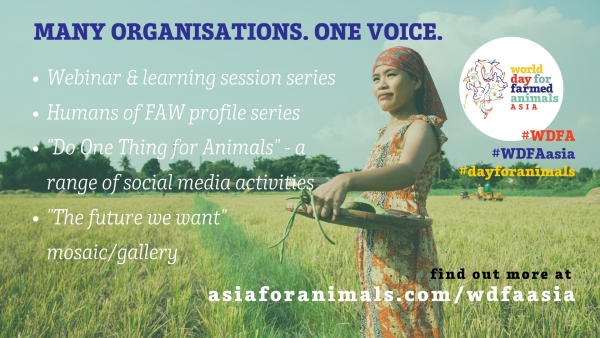 World Day for Farmed Animals Asia is on October 2nd… Read More
-
COVID-19 and the Development of the New Global Biodiversity Framework +
 The Convention on Biological Diversity (CBD) is an international agreement… Read More
- 1